

When explanations become excuses (without anyone meaning them to)
Educational researchers Helen Timperley and Viviane Robinson studied struggling schools and found something uncomfortable: improvement did not stall because teachers lacked effort or care. It stalled because schools shared explanations that quietly removed responsibility from classroom practice.
Not blame.
Not laziness.
Something subtler.
When the dominant explanation for weak learning sits outside the classroom, the classroom becomes a place where very little can change.
This is not a moral failure.
It is a human one.
We all protect ourselves from the emotional cost of believing that what we do every day might not yet be good enough.
The most dangerous sentence in a school
It usually sounds like this:
“Given our context, this is the best we can do.”
Large classes.
Limited resources.
Exam pressure.
Language barriers.
All real. All important. All true.
And yet this sentence quietly closes the door on improvement.
Because if the context explains everything, then teaching explains very little.
What actually changes schools (spoiler: it’s not motivation workshops)
Timperley and Robinson’s research points to a sobering conclusion: schools do not improve because teachers become more motivated, more positive, or more inspired. Improvement only began when three specific conditions were deliberately created together. Miss one, and very little changed.
Not new policies.
Not catchy slogans.
Not inspection pressure.
Three conditions.
1. Learning problems were made visible
Improvement started when schools stopped relying on abstract indicators and began looking closely at everyday classroom reality. Not exam results. Not league tables. But what learning actually looked like, minute by minute.
Leaders and teachers examined questions such as: how long does it take for pupils to settle and begin meaningful work? How often is learning interrupted by noise, movement, or unclear instructions? How much lesson time is genuinely spent thinking, practising, and responding, rather than waiting, copying, or listening passively?
When learning time is made visible in this way, it becomes much harder to rely on comfortable explanations. The conversation shifts from “why our context makes learning difficult” to “what is happening inside lessons that we can see and influence”.
2. Someone refused to accept the easiest explanation
In the research, change did not happen simply because data existed. It happened because a leader, coach, or external partner played a crucial role: they refused to let the first explanation be the final one.
When teachers attributed problems to pupils, families, background, or system pressures, this person asked careful but persistent questions. What else might explain what we are seeing? Which parts of this situation are within our influence as professionals? What happens inside the lesson that we have not yet tried to change?
This was not about blame or judgement. It was about professional honesty. Without someone willing to challenge assumptions, even strong evidence was explained away and existing practices remained comfortably intact.
3. Teachers were given something concrete to do differently
The final condition was the most practical, and arguably the most important. Teachers were not asked to adopt new beliefs, embrace new mindsets, or rethink their values. They were given specific, concrete routines to try in their classrooms.
Clear entry routines that protected the start of learning.
Consistent signals that reduced uncertainty.
Structured talk that increased participation.
Predictable responses that created safety and calm.
As teachers experienced lessons that were calmer, more focused, and more productive, their beliefs began to shift. Crucially, this change came after practice improved, not before. Success in the classroom reshaped thinking, not the other way around.
This is how schools actually change.
Why this matters so much in Bangladesh
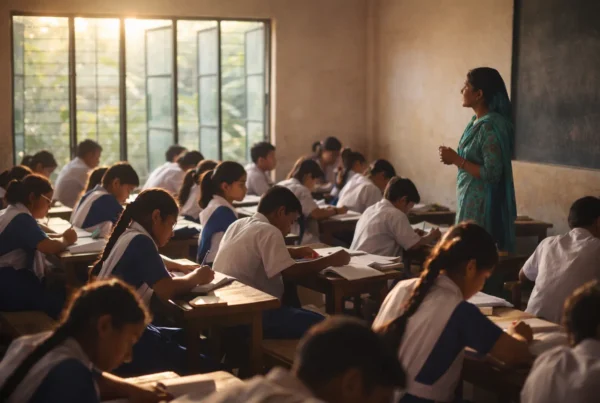
In Bangladesh, behaviour is rarely “bad” in the dramatic sense. But learning conditions are fragile.
Noise, pace, overcrowding, rushed teaching, and inconsistent expectations slowly erode learning, particularly for quieter pupils who are easiest to miss.
When improvement efforts stall, the explanation is often external.
“They are weak students.”
“They depend on coaching.”
“They don’t revise.”
What gets overlooked is the simplest and most powerful lever available to schools: the climate for learning inside the classroom.
A deliberately uncomfortable thought
What if the biggest barrier to improvement is not our context, but the story we tell ourselves about it?
What if changing routines is easier than changing beliefs, and changing beliefs only happens after routines start working?
What if leadership is not about inspiring people to think differently, but about helping them see something they can no longer explain away?
The EBTD position
At Evidence Based Teacher Development, we take a clear stance.
Schools improve when learning time is protected.
Learning time is protected through simple, shared routines.
Routines only stick when leaders challenge comfortable explanations.
Beliefs change after practice improves, not before.
This is not about blaming teachers.
It is about respecting the profession enough to believe that what happens in classrooms still matters.
Even here.
Especially here.
A final question for leaders
If you removed the most common explanation your school uses for learning problems, what would you have to look at next?
And what might finally change if you did?
If you found this useful, join the EBTD newsletter for monthly, research-backed tips, free classroom tools, and updates on our training in Bangladesh—no spam, just what helps. Sign up to the newsletter and please share this blog with colleagues or on your social channels so more teachers can benefit. Together we can improve outcomes and change lives.
Further reading
Timperley, H., & Robinson, V. (2001). Achieving school improvement through challenging and changing teachers’ schema.
Available via ResearchGate:
https://www.researchgate.net/profile/Viviane-Robinson/publication/225705447_Achieving_School_Improvement_through_Challenging_and_Changing_Teachers’_Schema/links/545299c80cf2cf51647a4734/Achieving-School-Improvement-through-Challenging-and-Changing-Teachers-Schema.pdf