

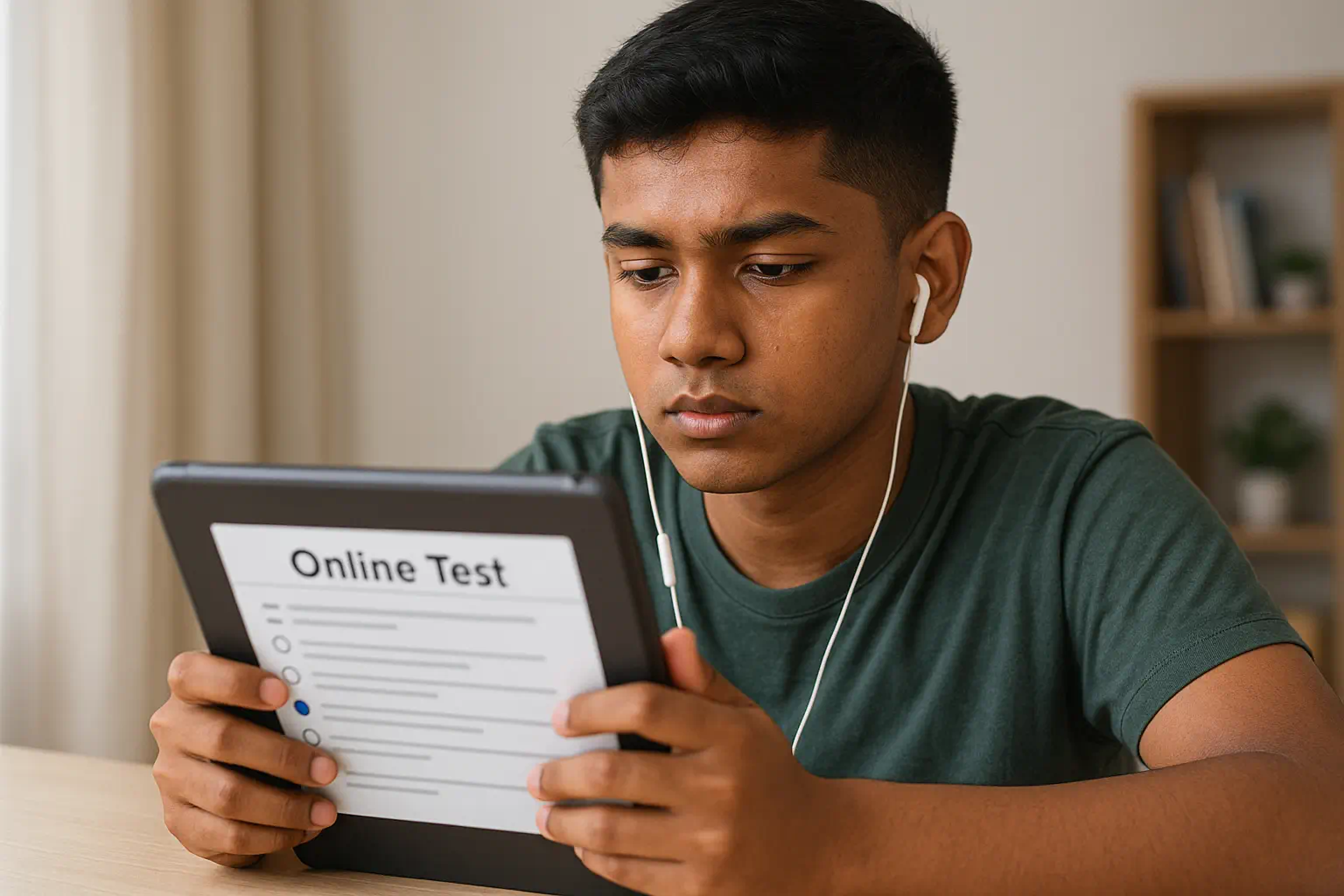
Do Digital Exams Harm Student Performance? The Evidence Might Surprise You
Why “screens feel easier” — and why that matters for teaching in Bangladesh
When you give students a digital exam, what do you expect to happen?
Will they score lower because it’s on a screen?
Will they become distracted, careless, or overconfident?
Or — the opposite — does the screen actually help them perform better?
These questions matter in Bangladesh. As schools begin using online platforms, digital question banks, and screen-based assessments, many teachers and principals are unsure what to trust. The fear is understandable: if the medium changes, will learning suffer?
A major 2025 study provides an unexpected answer — and an important warning for teachers.
(Full research link included below.)
The Myth-Busting Finding: Students Do NOT Perform Worse on Digital Exams
A large field study of 2,250 university students compared performance on paper exams versus e-exams taken on tablets. The researchers looked at:
-
Actual exam scores
-
Grades
-
Students’ estimates of their own performance
-
Perceptions of effort and difficulty
This wasn’t a lab experiment. These were real, high-stakes university exams — exactly the kind of situation where students give full effort.
The result?
There was no difference in performance.
Students scored the same whether the exam was on paper or on screen.
This finding challenges a long-standing belief, especially in South Asian education systems, that digital formats automatically weaken concentration or comprehension. According to the researchers:
“Data did not provide evidence for screen inferiority in exam performance or metacognitive accuracy.”
– Hoch et al., 2025 (Learning and Instruction)
Full research link:
https://www.sciencedirect.com/science/article/pii/S0959475225001501
This should reassure school leaders in Bangladesh who are piloting digital assessments or planning long-term digital transitions. The medium itself does not reduce achievement.
But the study revealed something else — something far more important for teachers.
The Real Issue: Students Feel Like Digital Exams Are Easier
Even though scores were identical, students consistently reported:
-
investing less effort
-
experiencing less difficulty
-
perceiving the exam as less demanding
This is crucial.
The brain’s feeling of difficulty is one of the strongest signals shaping how students study, revise, and manage their learning. When tasks feel easy, students often:
-
underestimate the challenge
-
revise less deeply
-
skim instead of process
-
rely on surface strategies
-
show overconfidence about their performance
In other words, digital assessments may not reduce performance on the day of the exam, but they can distort the mental cues students use to regulate their learning.
This is where the research connects powerfully with teaching in Bangladesh.
The Metacognition Message: Effort Feels Different on a Screen
One of the clearest implications of the research is this:
Students’ perception of effort can become miscalibrated on digital tasks.
When a screen makes a task feel easier, students may believe they have learned more than they actually have. This is a metacognitive problem — not a technological one.
In Bangladesh, where many learners already struggle with:
-
deep reading
-
sustained attention
-
revision strategies
-
self-monitoring
-
checking for accuracy
-
evaluating their own understanding
…the illusion of ease on screens could widen existing gaps.
The research warns us:
-
Performance remains stable in high-stakes conditions.
-
But outside high-stakes exams (homework, revision, classwork), students may think they are working hard when they are not.
This gap between effort felt and effort needed is a critical target for teacher practice.
What Teachers Should Do
Rather than fearing digital tools, teachers should actively guide students to manage their learning more accurately.
1. Teach deep-processing strategies explicitly
Students need structured habits for digital tasks:
-
annotating
-
summarising
-
questioning
-
planning their approach
-
checking answers deliberately
2. Train students to judge their own learning realistically
Help them ask:
-
“Do I really understand this, or does it just feel easy on the screen?”
-
“What evidence do I have that I’m ready?”
-
“Have I actually worked deeply, or just skimmed?”
3. Use the same high-quality instructional routines across both media
Digital vs. paper should not change:
-
the success criteria
-
the modelling of thinking
-
the use of worked examples
-
feedback and checking routines
4. Debrief the differences openly
Talk to students about:
-
why screens feel easier
-
how feeling easy doesn’t equal learning
-
how to regulate effort on digital tasks
This is metacognition in practice — and it matters enormously.
So, Should Bangladesh Move Toward Digital Exams?
Yes — if the transition is led by teachers who understand the psychology beneath the surface.
The research is clear:
-
Digital exams do not harm performance.
-
But they DO change students’ perception of how hard they are working.
-
Without guidance, this can lead to weaker revision habits and overconfidence.
The message for Bangladeshi schools is simple:
Do not fear digital exams.
Do teach students how to think about their learning when the screen makes things feel easier.
This is exactly where high-quality pedagogy and evidence-based practice matter most.
Full Research Citation and Link
Hoch, E., Stürmer, S., Jonkmann, K., & Scheiter, K. (2025). Paper-pencil vs. e-exams: Revisiting the screen inferiority effect during high-stakes testing at university. Learning and Instruction, 101, 102226.
Available at: https://www.sciencedirect.com/science/article/pii/S0959475225001501