Improving teaching and leadership is not simply about knowing more.
It is about doing something differently tomorrow, then keeping that change going long enough for it to matter.
Across the world, research shows that traditional training rarely changes classroom practice.
Teachers may leave a session inspired, but when they walk back into a busy Bangladeshi classroom,
old habits return.
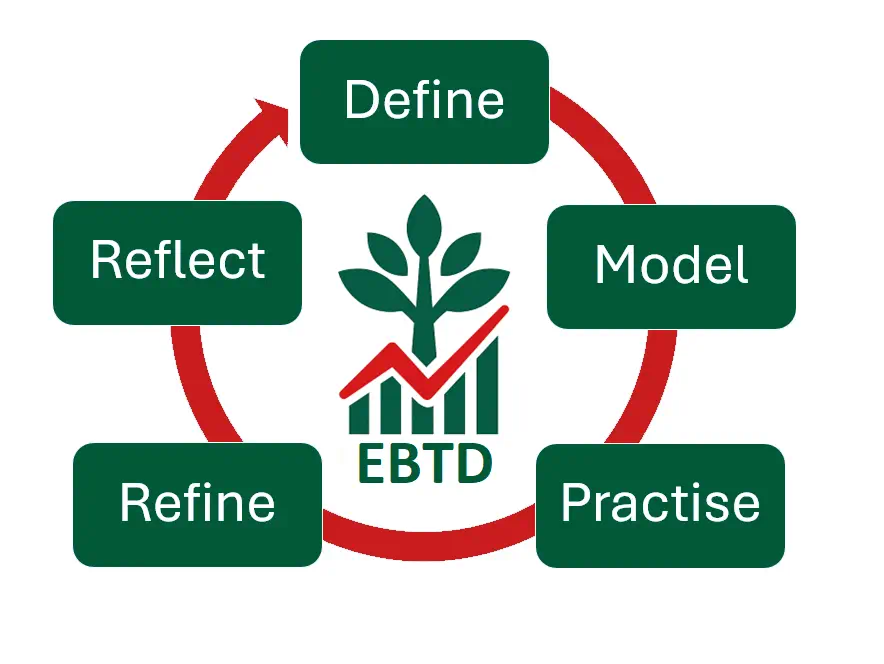
The EBTD Deliberate Practice Model is our response.
It is practical, evidence-based, and built for Bangladesh’s realities:
large classes, time pressure, and teachers who often receive more blame than support.
This five-stage cycle sits at the heart of every EBTD course.
It helps teachers and leaders make small, meaningful changes that grow into lasting professional improvement.
1. DEFINE — Choose one small change that matters
Most teachers and leaders want to improve, but they are overwhelmed by too many targets
or feedback that feels vague (“improve behaviour management”, “use better questioning”).
DEFINE helps you identify one small, realistic change that you can describe clearly,
that someone else could see, and that directly supports student learning or colleague clarity.
New teacher example
Rafi struggles to settle the class. Instead of “manage behaviour better,” his coach helps him define:
“Start every lesson with a simple routine so students settle in 30 seconds.”
Experienced teacher example
Shila sees only confident students answering. Her DEFINE:
“Use no-hands questioning to involve more students.”
Leader example
Mahmud’s meetings are unclear. His DEFINE:
“Begin each meeting with: What change do you want to see?”
Many teachers have never seen effective practice broken down clearly.
MODEL shows exactly what the change looks like, step by step, in a Bangladeshi context.
Break into 2–4 simple steps
Show a realistic example (live or video)
Explain why each step helps learning
New teacher example
Rafi watches a calm lesson start being modelled:
stand still → signal → welcome → clear task.
Experienced teacher example
Shila sees a respectful cold-calling demonstration and realises: “I can do that tomorrow.”
Leader example
Mahmud watches a 4-step coaching routine being modelled and sees how clarity and empathy work together.
Why it works
MODEL builds confidence:
“You don’t have to guess — here’s what it looks like.”
3. PRACTISE — Try it safely in short, low-stakes bursts
Teachers rarely get to practise teaching except in front of a full class.
Leaders practise only during real problems.
PRACTISE creates a safe, judgment-free space to try the new behaviour in small, repeatable scenarios.
30–60 second drills
role-plays
partner simulations
triad practice
New teacher example
Rafi practises his routine three times with a “noisy student”. It becomes calmer each attempt.
Experienced teacher example
Shila practises: pause → name → wait → probe.
It becomes smoother each time.
Leader example
Mahmud rehearses the first 60 seconds of a difficult conversation.
Awkward at first… then natural.
Why it works
Teaching is a performance profession.
PRACTISE makes improvement possible before trying it in front of students or staff.
4. REFINE — Improve it through tiny, specific adjustments
This is where real change happens.
After each short practice, the coach gives one tiny, concrete piece of feedback.
You try again.
Then again.
Each time smoother.
New teacher example
Rafi’s coach: “Wait two full seconds after your silence signal.”
He retries — and sees instant improvement.
Experienced teacher example
Shila adjusts to saying the student’s name after the question.
Inclusion rises.
Leader example
Mahmud practises summarising what a colleague said before giving direction.
Conversations flow.
Why it works
Without feedback + repetition, practice simply reinforces the old habit.
REFINE builds the new one.
5. REFLECT — Use it tomorrow and notice what happened
Reflection turns practice into new professional habits.
Teachers and leaders use the behaviour in real work, then briefly reflect:
Did I do it?
What changed?
How did students or colleagues respond?
What helped or blocked it?
What do I try next?
New teacher example
Rafi sees students settle faster and writes:
“Next time, stand still before speaking.”
Experienced teacher example
Shila notices quieter students contributing more when she pauses longer.
Leader example
Mahmud sees trust growing and decides to continue summarising before directing.
Why it works
REFLECT prevents slipping into old habits and creates long-term improvement.